Beltain
There is a great deal of misinformation circulated about this festival; almost as much as with Halloween. Read the following information and then go to the links to arm yourself with true information.There are four great festivals of the Witch's calendar. The two greatest of these are Nos Galon Gaeof (Halloween - the beginning of winter) and Nos Galon Mai (May Day - the beginning of summer). These two festivals are opposite each other on the wheel of the year, and divide the year into halves. Halloween (also called Samhain) is the Celtic New Year and is generally considered the more important of the two, though May Day runs a close second. Indeed, in some areas -- notably Wales -- it is considered the great holiday.
Nos Galon Mai, also called May Day, Beltainne: (pronounced Bel-tinna, also known as Beltain, Beltane, May Day etc.), is a Sabbat celebrating fertility and the union of the young God and the Goddess. This is a wonderful celebration of the love between the God and Goddess. It is their sacred marriage. (This is where the God and Goddess concieve the spring for the following year born at Imbolc.) Celebrated with your loved one, now is the time to lay in the fertile soil and germinate those seeds you planted. In Celtic mythology this is the beginning of summer, or the growing time. Colours for this sabbat: Red and White (red for Her womb and white for His semen. It's a fertility thing), and green for the background.
At this time, life is renewing itself. Birds and animals are mating. In the fields, newly planted seeds are beginning to grow. Great fires are lit honoring the fertility God Belenos. Some leap the fires to show the exuberance of the season. Maypoles are erected and bright ribbons are entwined around it. The Maypole, a phallic symbol, represents the masculine. The soft, colorful ribbons represent the feminine. The union of the two symbolizes the union of the God and Goddess. This is the time to fertilize your dreams with action. It is legend that children conceived at Beltane were gifted by the gods.
Nos Galon Mai ushers in the fifth month of the modern calendar year, the month of May. This month is named in honor of the goddess Maia, originally a Greek mountain nymph, later identified as the most beautiful of the Seven Sisters, the Pleiades. By Zeus, she is also the mother of Hermes, god of magic. Maia's parents were Atlas and Pleione, a sea nymph.
The old Celtic name for May Day is Beltane (in its most popular Anglicized form), which is derived from the Irish Gaelic 'Bealtaine' or the Scottish Gaelic 'Bealtuinn', meaning 'Bel-fire', the fire of the Celtic god of light (Bel, Beli or Belinus). He, in turn, may be traced to the Middle Eastern god Baal.
Other names for May Day include: Cetsamhain ('opposite Samhain'), Walpurgisnacht (in Germany), and Roodmas (the medieval Church's name). This last came from Church Fathers who were hoping to shift the common people's allegiance from the Maypole (Pagan lingham - symbol of life) to the Holy Rood (the Cross - Roman instrument of death).
Incidentally, there is no historical justification for calling May 1st 'Lady Day'. For hundreds of years, that title has been proper to the Vernal Equinox (approx. March 21st), another holiday sacred to the Great Goddess. The nontraditional use of 'Lady Day' for May 1st is quite recent (within the last 15 years), and seems to be confined to America, where it has gained widespread acceptance among certain segments of the Craft population. This rather startling departure from tradition would seem to indicate an unfamiliarity with European calendar customs, as well as a lax attitude toward scholarship among too many Pagans. A simple glance at a dictionary ('Webster's 3rd' or O.E.D.), encyclopedia ('Benet's'), or standard mythology reference (Jobe's 'Dictionary of Mythology, Folklore & Symbols') would confirm the correct date for Lady Day as the Vernal Equinox.
By Celtic reckoning, the actual Beltane celebration begins on sundown of the preceding day, April 30, because the Celts always figured their days from sundown to sundown. And sundown was the proper time for Druids to kindle the great Bel-fires on the tops of the nearest beacon hill (such as Tara Hill, Co. Meath, in Ireland). These 'need-fires' had healing properties, and sky-clad Witches would jump through the flames to ensure protection.
Frequently, cattle would also be driven between two such bon-fires (oak wood was the favorite fuel for them) and, on the morrow, they would be taken to their summer pastures.
Other May Day customs include: walking the circuit of one's property ('beating the bounds'), repairing fences and boundary markers, processions of chimney-sweeps and milk maids, archery tournaments, morris dances, sword dances, feasting, music, drinking, and maidens bathing their faces in the dew of May morning to retain their youthful beauty.
In the words of Witchcraft writers Janet and Stewart Farrar, the Beltane celebration was principly a time of '...unashamed human sexuality and fertility.' Such associations include the obvious phallic symbolism of the Maypole and riding the hobby horse. Even a seemingly innocent children's nursery rhyme, 'Ride a cock horse to Banburry Cross...' retains such memories. And the next line '...to see a fine Lady on a white horse' is a reference to the annual ride of 'Lady Godiva' though Coventry. Every year for nearly three centuries, a sky-clad village maiden (elected Queen of the May) enacted this Pagan rite, until the Puritans put an end to the custom.
The Puritans, in fact, reacted with pious horror to most of the May Day rites, even making Maypoles illegal in 1644. They especially attempted to suppress the 'greenwood marriages' of young men and women who spent the entire night in the forest, staying out to greet the May sunrise, and bringing back boughs of flowers and garlands to decorate the village the next morning.
One angry Puritan wrote that men 'doe use commonly to runne into woodes in the night time, amongst maidens, to set bowes, in so muche, as I have hearde of tenne maidens whiche went to set May, and nine of them came home with childe.' And another Puritan complained that, of the girls who go into the woods, 'not the least one of them comes home again a virgin.'
Long after the Christian form of marriage (with its insistence on sexual monogamy) had replaced the older Pagan handfasting, the rules of strict fidelity were always relaxed for the May Eve rites. Names such as Robin Hood, Maid Marian, and Little John played an important par in May Day folklore, often used as titles for the dramatis personae of the celebrations. And modern surnames such as Robinson, Hodson, Johnson, and Godkin may attest to some distant May Eve spent in the woods.
These wildwood antics have inspired writers such as Kipling:
Oh, do not tell the Priest our plight,
Or he would call it a sin; But we have been out in the woods all night,
A-conjuring Summer in!
IMPORTANT!!
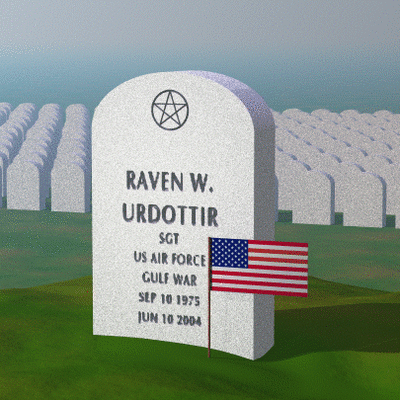
Please sign our petition to have The Pentacle placed on headstones of Pagan Veterans who have passed through the Vail
Just Click The Headstone
First a note on my name Owyn the Celt:
In the Thirteenth Century outside Naples, Italy was the town of Ben Vinuto. A Which named Aradia lived there. The New mayor was a christian & wanted to eliminate her & her followers.
Aradia founding out about the attack gave her writings to her followers & told them to flee. When the solders arrived only Aradia was there. As they attacked her and kilted man known only as Owyn the Celt defended her, taking several solders before being killed, but it gave Aradia a chance to escape.
Blessed be.
As you travel around my site clicking on
Menu
will bring you to the buttons below
from which you can navigate
















Looking for something in Particular??
Try This!!