THE WHEEL OF THE YEAR
(AN ORAL TEACHING OF THE FAERY
TRADITION OF WITCHCRAFT)
In love, the Horned God, changing form and changing face,
ever seeks the Goddess. In this world, the search and the seeking
appear in the Wheel of the Year.
She is the Great Mother who gives birth to Him as the Divine Child Sun at the Winter Solstice. In spring, He is sower and seed who grows with the growing light, green as the new shoots.She isthe Initiatrix who teaches Him the mysteries. He is the young bull; She the nymph, seductress.
In summer, when light is longest, they meet in union, and the strength of their passion sustains the world. But the God's face darkens as the sun grows weaker, until at last, when the grain is cut for harvest, He too sacrifices Himself to Self that all may be nourished.
She is the reaper, the grave of earth to which all must return. Throughout
the long nights and darkening days, He sleeps in her womb; in dreams, He is Lord of Death who rules the Land of Youth beyond the gates of night and day.
His dark tomb becomes the womb of
rebirth, for at Midwinter She again gives birth to Him.
The cycle ends and begins again, and the Wheel of the Year turns, on and on
The Wheel of the Year holds several purposes, both theological and practical. Theologically, the story of the Wheel often varies depending on the Tradition. The Wheel gives the accounts of the mythological events that repeat throughout the year as well as a vague "history" of the Gods and Goddesses involved within the pantheon. For the newbies, by "Tradition" we mean "denomination"; for example Wiccan, Celtic, Druid, Native American, etc. On the more practical side, the Wheel trains us to be able to deal with death and the inevitability of re-birth that follows. Paganism teaches that death, a natural function of the universe, is a part of life; a dramatic change that is the beginning of a new experience, and something to be celebrated at the proper time not feared (not condoning Suicide!) Through the ideas of Heaven and Hell, Christianity teaches a deep fear of death, and this spurs our society's horror of death. We are always trying to find new and improved ways to beat death, but we will never succeed. It is sad our society portrays death as such a terrifying experience; we would certainly have less emotional pain and suffering in the world if death could be seen as what it is: a transformation, nothing more. .
.
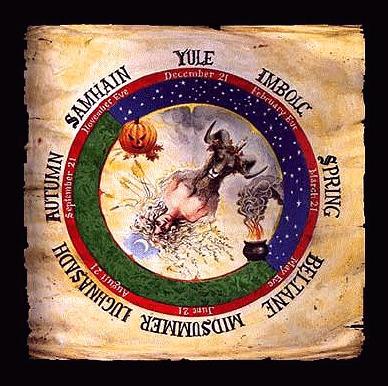
Click the Sabats & the Cross Quarter days in the graphic above to view a discription of each!